Recently, New Beginnings had an opportunity to interview a trailblazer in the field of human milk feeding. Love Anderson has made significant contributions to the world of La Leche League and beyond for breastfeeding families, and we are sharing part of her story below. This conversation arose from Love’s recent award at the Uplifting Black and Brown Lactation Success Conference for Innovation in Lactation.
Tell us a little about yourself: your personal lactation history, your history with LLL, and your involvement in the broader field of lactation.
 I’m Love Anderson, and I’m the President and CEO of Breastfeeding Family Friendly Communities, a public health project built around the Ten Steps to a Breastfeeding Family Friendly Community. We now support 14 community-led projects across the country, including Breastfeed Durham, the North Carolina Breastfeeding Coalition, and the SAFE Team.
My history with La Leche League started before I ever had a baby. I met my husband when we were teenagers, and his mother, Kathleen, was an LLL Leader. So I spent my teenage years in a house where there were pictures of lactation on the walls and a person at the kitchen table working on a master’s degree in early childhood education where, as it turned out, every major project she took on was about breastfeeding. My husband has been passionate about LLL ever since his little sister was born.
When I was a multiracial, outspoken fifteen-year-old challenging my future mother-in-law on race and gender, she didn’t retreat. She signed up for a race equity course at our local university. She was the only white woman in the room. I fully expected her to drop it. Instead, she showed up night after night, a stay-at-home mother with a teenager and a younger child, leaving her family every week to sit in a classroom and talk honestly about equity, power, and bias. She listened more than she spoke, and she stayed even when it was uncomfortable.That was the moment I fell in love with my husband’s family.
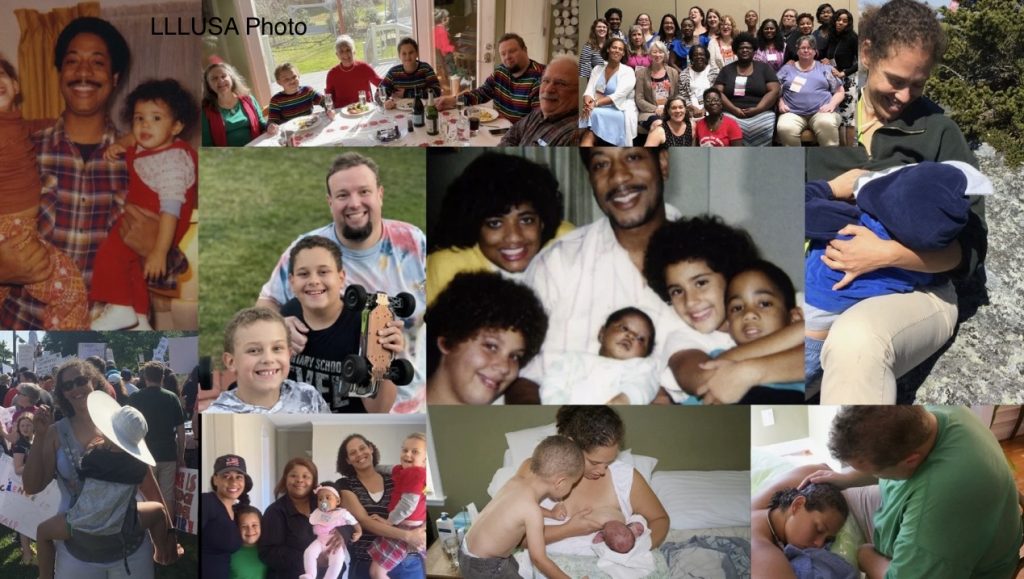
My own lactation work began when I breastfed my two children, both of whom have special needs. I went to four meetings while I was pregnant, and I want to be honest about what I noticed: not many people in the room looked like me.
After the birth of my son, my mother-in-law later worked at the Carolina Global Breastfeeding Institute on the Breastfeeding Friendly Childcare and Breastfeeding Friendly Cities initiatives, helping train a large share of this country’s childcare workforce on lactation-supportive policy. She is still my co-Leader, still my mentor, and she is the person who helped me turn my fears for my own children’s future into a career.
By 2014, I was accredited as a Leader, and I still lead with the LLL of Durham Group.
Eventually, the work grew past what one volunteer role could hold. Kathleen and I ended up co-founding Breastfeeding Family Friendly Communities (BFFC) because the level of systems change we wanted (hospitals, employers, childcare, emergency planning, policy) was bigger than what any group of volunteer Leaders had the hours for. That ambition was never outside what LLL cares about. It just needed somewhere to live. Today BFFC supports 14 community-led projects across the country. I also chair the North Carolina Breastfeeding Coalition, serve on the board of the U.S. Breastfeeding Committee, and co-founded SafeInfantFeeding.org.
And I’m still an active Leader.
Congratulations on receiving the Innovation in Human Lactation Award! What did receiving this award mean to you?
It was totally a surprise. It was an honor and a privilege to be recognized. I’m grateful that my hard work is seen by my peers.
When I sat with the name of that award, I understood what it was really recognizing: the work after Hurricane Helene, standing for up support for clinicians and families in Western North Carolina, and bringing national attention to a policy gap that should never have existed around infant and young child feeding in emergencies.
But an innovation award for emergency response tells on this country, if you listen closely.
If we had the infrastructure to support families through the micro-emergencies that happen every single day–the ones the Black community is acutely aware of as a result of systemic racism–there would have been no need for innovation when Helene hit. A power outage in an apartment complex. A boil-water advisory. An eviction. A pump that breaks the week a mother goes back to work. An empty formula shelf on the one night the bus is running late. Those are emergencies, too. They just don’t make the news.
Black and Brown families have never had the luxury of waiting for systems to show up, so they built their own: the auntie who knows how to hand express, the church that opens its doors, the neighbor who watches the baby, the peer counselor who answers the phone at midnight. That is collective power, and it is one of the oldest emergency response systems in America.
Helene didn’t reveal a new problem. It revealed, at scale, the problem that families I work with in Durham have been navigating quietly all along, and it proved the community-rooted model works. I hope this country is finally ready to invest in what these communities have always known how to do: keeping families fed.
So what I’m celebrating isn’t an award. It’s a movement.
For readers who may not be familiar with it, can you tell us about the Uplifting Black and Brown Lactation Success (UBBLS) Conference? How did the conference come about, and what was the vision behind it?
I want to be careful here, because this isn’t my conference, and I don’t want to accept credit that belongs to other people. I go as a participant, and this year as an award recipient.
UBBLS is hosted by North Carolina A&T State University’s Human Lactation Pathway 2 Program, together with Reaching Our Sisters Everywhere (ROSE). The lineage matters. Johnson C. Smith University blazed the trail as the first HBCU (Historically Black Colleges and Universities) in the country to offer a lactation consultant training program. NC A&T picked up that torch and has been a public university graduating cohort after cohort of brilliant lactation professionals. In 2024, they built UBBLS, the first lactation conference ever hosted at an HBCU, so that this growing community would have a home. Standing over all of it is the legacy of Dr. Kimarie “Mama Bugg” Bugg, the first Black IBCLC, and ROSE, who co-host that gathering every year.
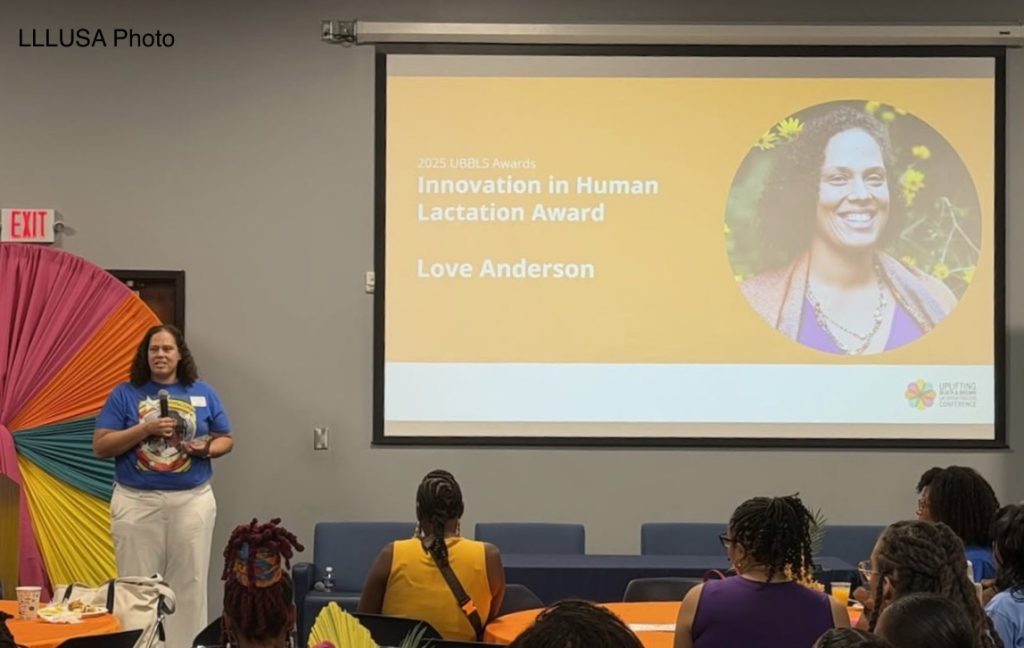 The vision, as the organizers describe it, is to examine the structural barriers that keep Black and Brown professionals out of this field, and out of leadership in it, and to deepen the connections among the people doing the work anyway. This year’s theme was “From Restoration to Revolution: Bridging Policy, Practice, and Partnership,” and it ran August 6-7 in Greensboro, with a white coat ceremony for the new cohort the evening before.
I want to be transparent about something. Dr. Kimarie Bugg, “Mama Bugg” tells this story openly: her journey started with a call to a La Leche League Leader in Atlanta that was never returned. Back then, you could tell what part of town someone was from by their phone number, and she has always believed that is why no one called her back. I have sat in the room at the Uplifting Black and Brown Lactation Success Conference and heard her tell it, as a La Leche League Leader.
So it is not lost on me that in these Black and Brown spaces, I am the one who openly identifies as a Leader. LLL trained me. It changed everything for me. I have joyfully been welcomed and loved by Leaders all over the country, especially the Black and Brown Leaders that have supported and mentored me in this work over the years. I couldn’t have done it without them. But the depth to which LLL has impacted lactation in this country, especially Black and Brown Lactation, is not visible to most IBCLCs, especially those whom we disappointed as moms.
LLL taught me how to support families. It taught me how to lean into my power. It taught me how to communicate. The women I met there are still some of my closest friends, my strongest supporters, and the advocates who got this movement started.
Two things can be true at once.
What I’d tell New Beginnings readers is this: if you have ever wondered where the next generation of Black and Brown IBCLCs is coming from, they are being trained at HBCUs, and once a year they all end up in the same room in Greensboro for this conference. It is a joyful place to be.
Stay tuned for the second part of this wonderful and enriching interview with Love Anderson next week.
Supporting Breastfeeding Families–Today, Tomorrow, Always
Please consider donating to La Leche League USA.
Your gift helps support this blog and the website!
Donations of any amount are gratefully accepted. Thank you!
Follow us on:


Leave a Comment
Posted: November 3, 2026 by Yael Breimer
An Interview with Love Anderson: Innovation in Lactation Award Recipient – Part 1
Recently, New Beginnings had an opportunity to interview a trailblazer in the field of human milk feeding. Love Anderson has made significant contributions to the world of La Leche League and beyond for breastfeeding families, and we are sharing part of her story below. This conversation arose from Love’s recent award at the Uplifting Black and Brown Lactation Success Conference for Innovation in Lactation.
Tell us a little about yourself: your personal lactation history, your history with LLL, and your involvement in the broader field of lactation.
My history with La Leche League started before I ever had a baby. I met my husband when we were teenagers, and his mother, Kathleen, was an LLL Leader. So I spent my teenage years in a house where there were pictures of lactation on the walls and a person at the kitchen table working on a master’s degree in early childhood education where, as it turned out, every major project she took on was about breastfeeding. My husband has been passionate about LLL ever since his little sister was born.
When I was a multiracial, outspoken fifteen-year-old challenging my future mother-in-law on race and gender, she didn’t retreat. She signed up for a race equity course at our local university. She was the only white woman in the room. I fully expected her to drop it. Instead, she showed up night after night, a stay-at-home mother with a teenager and a younger child, leaving her family every week to sit in a classroom and talk honestly about equity, power, and bias. She listened more than she spoke, and she stayed even when it was uncomfortable.That was the moment I fell in love with my husband’s family.
My own lactation work began when I breastfed my two children, both of whom have special needs. I went to four meetings while I was pregnant, and I want to be honest about what I noticed: not many people in the room looked like me.
After the birth of my son, my mother-in-law later worked at the Carolina Global Breastfeeding Institute on the Breastfeeding Friendly Childcare and Breastfeeding Friendly Cities initiatives, helping train a large share of this country’s childcare workforce on lactation-supportive policy. She is still my co-Leader, still my mentor, and she is the person who helped me turn my fears for my own children’s future into a career.
By 2014, I was accredited as a Leader, and I still lead with the LLL of Durham Group.
Eventually, the work grew past what one volunteer role could hold. Kathleen and I ended up co-founding Breastfeeding Family Friendly Communities (BFFC) because the level of systems change we wanted (hospitals, employers, childcare, emergency planning, policy) was bigger than what any group of volunteer Leaders had the hours for. That ambition was never outside what LLL cares about. It just needed somewhere to live. Today BFFC supports 14 community-led projects across the country. I also chair the North Carolina Breastfeeding Coalition, serve on the board of the U.S. Breastfeeding Committee, and co-founded SafeInfantFeeding.org.
And I’m still an active Leader.
Congratulations on receiving the Innovation in Human Lactation Award! What did receiving this award mean to you?
It was totally a surprise. It was an honor and a privilege to be recognized. I’m grateful that my hard work is seen by my peers.
When I sat with the name of that award, I understood what it was really recognizing: the work after Hurricane Helene, standing for up support for clinicians and families in Western North Carolina, and bringing national attention to a policy gap that should never have existed around infant and young child feeding in emergencies.
But an innovation award for emergency response tells on this country, if you listen closely.
If we had the infrastructure to support families through the micro-emergencies that happen every single day–the ones the Black community is acutely aware of as a result of systemic racism–there would have been no need for innovation when Helene hit. A power outage in an apartment complex. A boil-water advisory. An eviction. A pump that breaks the week a mother goes back to work. An empty formula shelf on the one night the bus is running late. Those are emergencies, too. They just don’t make the news.
Black and Brown families have never had the luxury of waiting for systems to show up, so they built their own: the auntie who knows how to hand express, the church that opens its doors, the neighbor who watches the baby, the peer counselor who answers the phone at midnight. That is collective power, and it is one of the oldest emergency response systems in America.
Helene didn’t reveal a new problem. It revealed, at scale, the problem that families I work with in Durham have been navigating quietly all along, and it proved the community-rooted model works. I hope this country is finally ready to invest in what these communities have always known how to do: keeping families fed.
So what I’m celebrating isn’t an award. It’s a movement.
For readers who may not be familiar with it, can you tell us about the Uplifting Black and Brown Lactation Success (UBBLS) Conference? How did the conference come about, and what was the vision behind it?
I want to be careful here, because this isn’t my conference, and I don’t want to accept credit that belongs to other people. I go as a participant, and this year as an award recipient.
UBBLS is hosted by North Carolina A&T State University’s Human Lactation Pathway 2 Program, together with Reaching Our Sisters Everywhere (ROSE). The lineage matters. Johnson C. Smith University blazed the trail as the first HBCU (Historically Black Colleges and Universities) in the country to offer a lactation consultant training program. NC A&T picked up that torch and has been a public university graduating cohort after cohort of brilliant lactation professionals. In 2024, they built UBBLS, the first lactation conference ever hosted at an HBCU, so that this growing community would have a home. Standing over all of it is the legacy of Dr. Kimarie “Mama Bugg” Bugg, the first Black IBCLC, and ROSE, who co-host that gathering every year.
I want to be transparent about something. Dr. Kimarie Bugg, “Mama Bugg” tells this story openly: her journey started with a call to a La Leche League Leader in Atlanta that was never returned. Back then, you could tell what part of town someone was from by their phone number, and she has always believed that is why no one called her back. I have sat in the room at the Uplifting Black and Brown Lactation Success Conference and heard her tell it, as a La Leche League Leader.
So it is not lost on me that in these Black and Brown spaces, I am the one who openly identifies as a Leader. LLL trained me. It changed everything for me. I have joyfully been welcomed and loved by Leaders all over the country, especially the Black and Brown Leaders that have supported and mentored me in this work over the years. I couldn’t have done it without them. But the depth to which LLL has impacted lactation in this country, especially Black and Brown Lactation, is not visible to most IBCLCs, especially those whom we disappointed as moms.
LLL taught me how to support families. It taught me how to lean into my power. It taught me how to communicate. The women I met there are still some of my closest friends, my strongest supporters, and the advocates who got this movement started.
Two things can be true at once.
What I’d tell New Beginnings readers is this: if you have ever wondered where the next generation of Black and Brown IBCLCs is coming from, they are being trained at HBCUs, and once a year they all end up in the same room in Greensboro for this conference. It is a joyful place to be.
Stay tuned for the second part of this wonderful and enriching interview with Love Anderson next week.
Supporting Breastfeeding Families–Today, Tomorrow, Always
Please consider donating to La Leche League USA.
Your gift helps support this blog and the website!
Donations of any amount are gratefully accepted. Thank you!
Follow us on:
Facebook
Category: National/International Events/Projects
Subscribe to Our Blog
Upcoming events:
La Leche League Meetings