Alexia’s Story: The Realities of Breastfeeding Beyond One Year
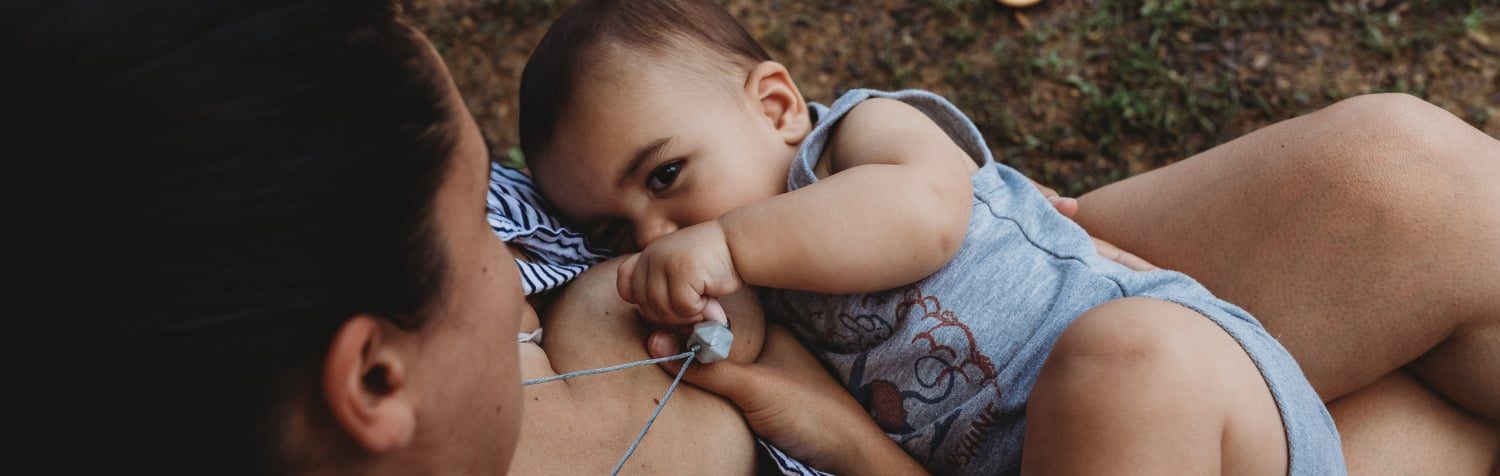
Alexia nursing her daughter.
Alexia DaSilva, Dartmouth, Massachusetts
Breastfeeding past the first year of life is recommended by multiple health organizations, including the American Academy of Pediatrics (AAP), Centers for Disease Control and Prevention (CDC), World Health Organization (WHO), and United Nations International Children’s Emergency Fund (UNICEF). While the science behind extended breastfeeding is easy to find, the realities are often not well known.
Currently, I am nursing my daughter, who will be three years old this coming June. I know that it benefits her for numerous reasons. In addition to making up for some nutrients she might be missing during her “picky (eating) phases” and helping to strengthen our bond, it also decreases my risk of breast cancer.
Yet sometimes I still feel isolated and alone. And that’s likely because I know so few other parents who are breastfeeding beyond one year. The unfortunate reality is that this is still considered taboo in many western countries, including the United States. There is incorrect information that many still believe, such as: breast milk loses its nutritional value after a certain age, lactating parents need to wean once the child begins growing teeth, and so on.
I am incredibly proud that I am still breastfeeding. Very few in my family have breastfed. Due to my own struggles (my daughter had an undiagnosed lip-tie, poor hospital support, top-up traps*, returning to work at eight weeks postpartum, working full time while also finishing my undergraduate degree, and becoming a single mother almost immediately), I never thought I would make it six months, much less more than two years. Now I am trying to wait until my daughter is ready to self-wean.
Despite my pride and ability to overcome adversity, I still feel uncomfortable nursing my daughter publicly. It’s not because I feel that I am doing something wrong, but I see the staring and uncomfortable glances projected on me, slowly removing my confidence to feed in public. Why is it considered normal to give children a carton of milk from another species, but weird to give them milk that is biologically created for them?
It is also often difficult to receive empathy and support. Whenever I complain about my weight gain, discomfort, nipple pain, or overall sheer parenting exhaustion, I am met with, “You should really wean her. Isn’t she old enough for cows’ milk?” There are some who ignore what is medically recommended and instead project their own ignorance and bias. This directly hurts lactating parents and toddlers, by indirectly forcing them to wean prematurely. And it furthers my feelings of isolation.
But at the end of the day, it is 100% worth it. Nothing is nicer than watching my sweet girl look up at me, holding my hand and smiling while she nurses first thing in the morning. There is a special joy about listening to a child directly tell you about nursing, validating your assumptions that it is their comfort and safe space, in addition to a valid form of nourishment. Watching my toddler grow as she continues to nurse is almost as satisfying as watching her fat rolls form in infancy. The thought that there is something I can provide her with that no one else can, that psychologically and physiologically links us in the most magical way, brings me immense joy.
I will continue to nurse for her emotional and nutritional/health needs until she is ready to wean, but I admit that I will be devastated when she eventually weans. In the meantime, I am still in awe of the sheer magic that is breastfeeding (it helps get her to sleep, calms her down during an emotional moment, fills the gaps in nutrition when she is picky, and helps keep her healthy when ill). Seeing the joy that it brings her brings me so much hope and happiness.
*Top-up trap refers to “topping up” a feeding by supplementing at the end of the feed.
We use cookies on our website to give you the most relevant experience by remembering your preferences and repeat visits. By clicking “Accept”, you consent to the use of ALL the cookies.
This website uses cookies to improve your experience while you navigate through the website. Out of these, the cookies that are categorized as necessary are stored on your browser as they are essential for the working of basic functionalities of the website. We also use third-party cookies that help us analyze and understand how you use this website. These cookies will be stored in your browser only with your consent. You also have the option to opt-out of these cookies. But opting out of some of these cookies may affect your browsing experience.
Necessary cookies are absolutely essential for the website to function properly. These cookies ensure basic functionalities and security features of the website, anonymously.
Cookie
Duration
Description
cookielawinfo-checkbox-analytics
11 months
This cookie is set by GDPR Cookie Consent plugin. The cookie is used to store the user consent for the cookies in the category "Analytics".
cookielawinfo-checkbox-functional
11 months
The cookie is set by GDPR cookie consent to record the user consent for the cookies in the category "Functional".
cookielawinfo-checkbox-necessary
11 months
This cookie is set by GDPR Cookie Consent plugin. The cookies is used to store the user consent for the cookies in the category "Necessary".
cookielawinfo-checkbox-others
11 months
This cookie is set by GDPR Cookie Consent plugin. The cookie is used to store the user consent for the cookies in the category "Other.
cookielawinfo-checkbox-performance
11 months
This cookie is set by GDPR Cookie Consent plugin. The cookie is used to store the user consent for the cookies in the category "Performance".
viewed_cookie_policy
11 months
The cookie is set by the GDPR Cookie Consent plugin and is used to store whether or not user has consented to the use of cookies. It does not store any personal data.
Functional cookies help to perform certain functionalities like sharing the content of the website on social media platforms, collect feedbacks, and other third-party features.
Performance cookies are used to understand and analyze the key performance indexes of the website which helps in delivering a better user experience for the visitors.
Analytical cookies are used to understand how visitors interact with the website. These cookies help provide information on metrics the number of visitors, bounce rate, traffic source, etc.
Advertisement cookies are used to provide visitors with relevant ads and marketing campaigns. These cookies track visitors across websites and collect information to provide customized ads.

Leave a Comment
Last Updated: February 25, 2021 by Yael Breimer
Alexia’s Story: The Realities of Breastfeeding Beyond One Year
Alexia DaSilva, Dartmouth, Massachusetts
Breastfeeding past the first year of life is recommended by multiple health organizations, including the American Academy of Pediatrics (AAP), Centers for Disease Control and Prevention (CDC), World Health Organization (WHO), and United Nations International Children’s Emergency Fund (UNICEF). While the science behind extended breastfeeding is easy to find, the realities are often not well known.
Currently, I am nursing my daughter, who will be three years old this coming June. I know that it benefits her for numerous reasons. In addition to making up for some nutrients she might be missing during her “picky (eating) phases” and helping to strengthen our bond, it also decreases my risk of breast cancer.
Yet sometimes I still feel isolated and alone. And that’s likely because I know so few other parents who are breastfeeding beyond one year. The unfortunate reality is that this is still considered taboo in many western countries, including the United States. There is incorrect information that many still believe, such as: breast milk loses its nutritional value after a certain age, lactating parents need to wean once the child begins growing teeth, and so on.
I am incredibly proud that I am still breastfeeding. Very few in my family have breastfed. Due to my own struggles (my daughter had an undiagnosed lip-tie, poor hospital support, top-up traps*, returning to work at eight weeks postpartum, working full time while also finishing my undergraduate degree, and becoming a single mother almost immediately), I never thought I would make it six months, much less more than two years. Now I am trying to wait until my daughter is ready to self-wean.
Despite my pride and ability to overcome adversity, I still feel uncomfortable nursing my daughter publicly. It’s not because I feel that I am doing something wrong, but I see the staring and uncomfortable glances projected on me, slowly removing my confidence to feed in public. Why is it considered normal to give children a carton of milk from another species, but weird to give them milk that is biologically created for them?
It is also often difficult to receive empathy and support. Whenever I complain about my weight gain, discomfort, nipple pain, or overall sheer parenting exhaustion, I am met with, “You should really wean her. Isn’t she old enough for cows’ milk?” There are some who ignore what is medically recommended and instead project their own ignorance and bias. This directly hurts lactating parents and toddlers, by indirectly forcing them to wean prematurely. And it furthers my feelings of isolation.
But at the end of the day, it is 100% worth it. Nothing is nicer than watching my sweet girl look up at me, holding my hand and smiling while she nurses first thing in the morning. There is a special joy about listening to a child directly tell you about nursing, validating your assumptions that it is their comfort and safe space, in addition to a valid form of nourishment. Watching my toddler grow as she continues to nurse is almost as satisfying as watching her fat rolls form in infancy. The thought that there is something I can provide her with that no one else can, that psychologically and physiologically links us in the most magical way, brings me immense joy.
I will continue to nurse for her emotional and nutritional/health needs until she is ready to wean, but I admit that I will be devastated when she eventually weans. In the meantime, I am still in awe of the sheer magic that is breastfeeding (it helps get her to sleep, calms her down during an emotional moment, fills the gaps in nutrition when she is picky, and helps keep her healthy when ill). Seeing the joy that it brings her brings me so much hope and happiness.
*Top-up trap refers to “topping up” a feeding by supplementing at the end of the feed.
Resources
Please send your story ideas to Amy at [email protected].
Please consider donating to La Leche League USA.
Donations of any amount are gratefully accepted. Thank you!
Category: Criticism, Extended breastfeeding
Subscribe to Our Blog
Upcoming events:
La Leche League Meetings