By Jamie P.
Editor’s note: May is Maternal Mental Health Awareness Month. Jamie shares her story with us this week and next about how finding a sleep solution that worked for her family helped improve her postpartum experience and overall mental health. If you or a loved one is struggling with mental health in parenthood, please see the resources at the end of this article.
I’m a mom of two amazing daughters (ages three and seven). I’ve been a La Leche League Leader for 6 years. This is a two-part story of how breastsleeping revolutionized my motherhood journey and was key to supporting my mental health as a new mom. Transporting myself back seven years, I didn’t know anything about safe bedsharing, the Safe Sleep 7, or the definition of breastsleeping. Breastsleeping is when a breastfeeding dyad intentionally and safely shares a sleeping surface. If you had asked me my thoughts on sharing a bed with your baby when I was pregnant with my first child, I would have probably said that seems pretty strange…. or even radical.
My husband and I prepared for the American cultural standard way to help your baby sleep: a bassinet, swaddling, pacifiers. We learned from our pediatrician about the ABCs of sleep and the urgency–so they told us–of following those rules to the letter. Babies should always sleep alone on their backs and in a crib; anything beyond that would be unsafe, negligent, doing a poor job at this very important role of being a parent. I absolutely planned to breastfeed and to be a very hands-on and nurturing mother. I had no idea that for my family, and many others, separating my baby and me for sleep would be counterproductive to breastfeeding. And I certainly didn’t know that following the so-called “right way” would cause me so much struggle and pain.
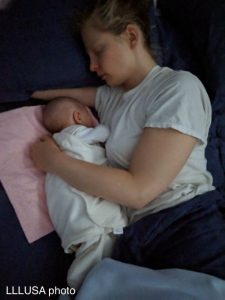 I delivered my first daughter naturally at a birth center that was embedded within a hospital. I was (and remain) so proud to have an unmedicated, physiological birth. Unfortunately, birth caused some significant postpartum tearing, which made it very painful for me to sit upright. Despite this, the nurses and lactation staff taught me only two nursing positions: cross cradle and cradle. They also would not let my daughter be on the bed with me in the birthing suite. My husband and I were there for two days because my daughter’s birth weight was a bit low, although she was perfectly healthy and full term. The whole time, I was trying to learn how to feed her and care for her while sitting up, in pain, and struggling to sleep due to her (very smart) insistence to be held. My beautiful daughter flat out rejected the bassinet and instead told my husband and I that she needed our direct comfort.
We went home feeling relieved; yet, once there, we dutifully continued the same behaviors we were taught in the hospital –holding her in arms for nursing, then swaddling her, and putting her down alone in the bassinet to sleep. I’ve since learned that while some babies don’t mind solo sleeping, my daughter was never one of those infants. She needed to be with us, especially me, non-stop. I had no way to meet her needs and also attend to my own, despite my husband’s ongoing support and hands-on help. She was too small to be safely worn in the baby wrap (per the label seven pounds was required), so that didn’t seem like an option for us to comfort and care for her.
I was in a very tough place emotionally and mentally, as well as struggling to heal physically from birth. Breastfeeding was going poorly, even though my daughter and I had the basics down. Her size and my growing milk supply required more time on the breast than I had anticipated at the time. The messages I was getting from our pediatrician led me to believe that every three hours was sufficient and that I should take my daughter off the breast when she fell asleep. Of course, now I know there’s no such thing as too much time on the breast (as long as the nursing parent is comfortable and the baby is content). Staying latched during sleep is a good way to get more letdowns, and nursing as much as possible throughout each 24-hour period can help build supply and transfer more calories.
A month in, my body was still healing. I was up all night getting out of bed to get my daughter, holding her until she’d fall back asleep, then putting her in the bassinet, only to be unable to sleep or really relax, because I knew she’d be calling out to me at any moment. Our physical separation ensured neither she nor I had what we needed to truly recover. My brain started playing tricks on me. I had terrifying intrusive thoughts and even woke up once in a panic, with my arms reaching out into the blank space in the bed for my daughter who wasn’t there. Honestly it’s hard to even project myself back into that time seven-and-a-half years later. I didn’t know it at the time, but I was in the thick of postpartum depression and anxiety and had zero idea at all how to heal and start feeling better.
After realizing the pediatrician’s office lactation consultant wasn’t meeting our needs, we started working with a lactation consultant who came to our house. She left behind some materials about how humans were “carrying” mammals–pointing to the need to keep infants close–and pamphlets about the Safe Sleep 7. She also encouraged me to try the side-lying position. While still feeling overwhelmed, I slowly started seeing there might be another way.
At five weeks postpartum, I attended my first La Leche League (LLL) meeting, where I burst into tears as my emotional turmoil bubbled to the surface. I explained to the Group how I was triple feeding (breastfeeding, then pumping, and supplementing) and how completely unsustainable this was for us. As the kind participants shared their thoughts, I slowly started to build new knowledge and consider alternative behaviors that would be a better fit for what my daughter and I needed. Through LLL, I learned to offer the breast proactively (even when the baby is sleeping–a revolutionary thought for me at the time). LLL meetings were also the place where I first heard about cosleeping as a viable, practical, even commonly utilized solution to build supply and simultaneously care for a baby while getting some rest yourself. At first, I’ll admit I didn’t think it would be for me. I remember going home to tell my husband all I had learned in the meeting and characterized “breastsleeping” as something pretty “out there”. But the seeds had been planted.
Jamie’s story continues. Stay tuned to see how she implemented breastsleeping to meet her and her baby’s needs at night.
Resources:
lllusa.org/spotlight-on-sleep-resources/
llli.org/news/the-safe-sleep-seven/
llli.org/news/breastsleeping-why-breastfed-babies-sleep-differently/
llli.org/news/infant-sleep/
llli.org/my-story-of-breastfeeding-and-postpartum-depression/
llli.org/holding-the-mother-the-importance-of-mental-health-support/
lllusa.org/postpartum-mood-disorders/
Share your story with New Beginnings at [email protected]
Supporting Breastfeeding Families–Today, Tomorrow, Always

Please consider donating to La Leche League USA.
Your gift helps support this blog and the website!
Donations of any amount are gratefully accepted. Thank you!
Follow us on:



Leave a Comment
Last Updated: May 5, 2026 by Yael Breimer
Gaining Peace and Power Through Breastsleeping, Part 1
By Jamie P.
Editor’s note: May is Maternal Mental Health Awareness Month. Jamie shares her story with us this week and next about how finding a sleep solution that worked for her family helped improve her postpartum experience and overall mental health. If you or a loved one is struggling with mental health in parenthood, please see the resources at the end of this article.
I’m a mom of two amazing daughters (ages three and seven). I’ve been a La Leche League Leader for 6 years. This is a two-part story of how breastsleeping revolutionized my motherhood journey and was key to supporting my mental health as a new mom. Transporting myself back seven years, I didn’t know anything about safe bedsharing, the Safe Sleep 7, or the definition of breastsleeping. Breastsleeping is when a breastfeeding dyad intentionally and safely shares a sleeping surface. If you had asked me my thoughts on sharing a bed with your baby when I was pregnant with my first child, I would have probably said that seems pretty strange…. or even radical.
My husband and I prepared for the American cultural standard way to help your baby sleep: a bassinet, swaddling, pacifiers. We learned from our pediatrician about the ABCs of sleep and the urgency–so they told us–of following those rules to the letter. Babies should always sleep alone on their backs and in a crib; anything beyond that would be unsafe, negligent, doing a poor job at this very important role of being a parent. I absolutely planned to breastfeed and to be a very hands-on and nurturing mother. I had no idea that for my family, and many others, separating my baby and me for sleep would be counterproductive to breastfeeding. And I certainly didn’t know that following the so-called “right way” would cause me so much struggle and pain.
We went home feeling relieved; yet, once there, we dutifully continued the same behaviors we were taught in the hospital –holding her in arms for nursing, then swaddling her, and putting her down alone in the bassinet to sleep. I’ve since learned that while some babies don’t mind solo sleeping, my daughter was never one of those infants. She needed to be with us, especially me, non-stop. I had no way to meet her needs and also attend to my own, despite my husband’s ongoing support and hands-on help. She was too small to be safely worn in the baby wrap (per the label seven pounds was required), so that didn’t seem like an option for us to comfort and care for her.
I was in a very tough place emotionally and mentally, as well as struggling to heal physically from birth. Breastfeeding was going poorly, even though my daughter and I had the basics down. Her size and my growing milk supply required more time on the breast than I had anticipated at the time. The messages I was getting from our pediatrician led me to believe that every three hours was sufficient and that I should take my daughter off the breast when she fell asleep. Of course, now I know there’s no such thing as too much time on the breast (as long as the nursing parent is comfortable and the baby is content). Staying latched during sleep is a good way to get more letdowns, and nursing as much as possible throughout each 24-hour period can help build supply and transfer more calories.
A month in, my body was still healing. I was up all night getting out of bed to get my daughter, holding her until she’d fall back asleep, then putting her in the bassinet, only to be unable to sleep or really relax, because I knew she’d be calling out to me at any moment. Our physical separation ensured neither she nor I had what we needed to truly recover. My brain started playing tricks on me. I had terrifying intrusive thoughts and even woke up once in a panic, with my arms reaching out into the blank space in the bed for my daughter who wasn’t there. Honestly it’s hard to even project myself back into that time seven-and-a-half years later. I didn’t know it at the time, but I was in the thick of postpartum depression and anxiety and had zero idea at all how to heal and start feeling better.
After realizing the pediatrician’s office lactation consultant wasn’t meeting our needs, we started working with a lactation consultant who came to our house. She left behind some materials about how humans were “carrying” mammals–pointing to the need to keep infants close–and pamphlets about the Safe Sleep 7. She also encouraged me to try the side-lying position. While still feeling overwhelmed, I slowly started seeing there might be another way.
At five weeks postpartum, I attended my first La Leche League (LLL) meeting, where I burst into tears as my emotional turmoil bubbled to the surface. I explained to the Group how I was triple feeding (breastfeeding, then pumping, and supplementing) and how completely unsustainable this was for us. As the kind participants shared their thoughts, I slowly started to build new knowledge and consider alternative behaviors that would be a better fit for what my daughter and I needed. Through LLL, I learned to offer the breast proactively (even when the baby is sleeping–a revolutionary thought for me at the time). LLL meetings were also the place where I first heard about cosleeping as a viable, practical, even commonly utilized solution to build supply and simultaneously care for a baby while getting some rest yourself. At first, I’ll admit I didn’t think it would be for me. I remember going home to tell my husband all I had learned in the meeting and characterized “breastsleeping” as something pretty “out there”. But the seeds had been planted.
Jamie’s story continues. Stay tuned to see how she implemented breastsleeping to meet her and her baby’s needs at night.
Resources:
lllusa.org/spotlight-on-sleep-resources/
llli.org/news/the-safe-sleep-seven/
llli.org/news/breastsleeping-why-breastfed-babies-sleep-differently/
llli.org/news/infant-sleep/
llli.org/my-story-of-breastfeeding-and-postpartum-depression/
llli.org/holding-the-mother-the-importance-of-mental-health-support/
lllusa.org/postpartum-mood-disorders/
Share your story with New Beginnings at [email protected]
Supporting Breastfeeding Families–Today, Tomorrow, Always
Please consider donating to La Leche League USA.
Your gift helps support this blog and the website!
Donations of any amount are gratefully accepted. Thank you!
Follow us on:
Facebook
Instagram
Category: Breastfeeding and Sleep, Breastfeeding Support, Grateful For LLL USA, LLL Support, Maternal Mental Health Awareness Month, Mental Health, New Family
Subscribe to Our Blog
Upcoming events:
La Leche League Meetings