by Deaf and Hard of Hearing Breastfeeding Collective
Editor’s note: This year marks the second annual Deaf and Hard of Hearing Breastfeeding (DHHBF) Week, from September 16–22. This year’s theme, Close the Gap, Strengthen the Bridge: Community, Care & Connection seeks to underscore the importance of improving breastfeeding outcomes in the Deaf and Hard of Hearing (Deaf/HoH) Community. Read on for an interview between New Beginnings and the Deaf and Hard of Hearing Breastfeeding Collective (DHHBFC). Learn more through the DHHBFC Facebook page or Instagram.
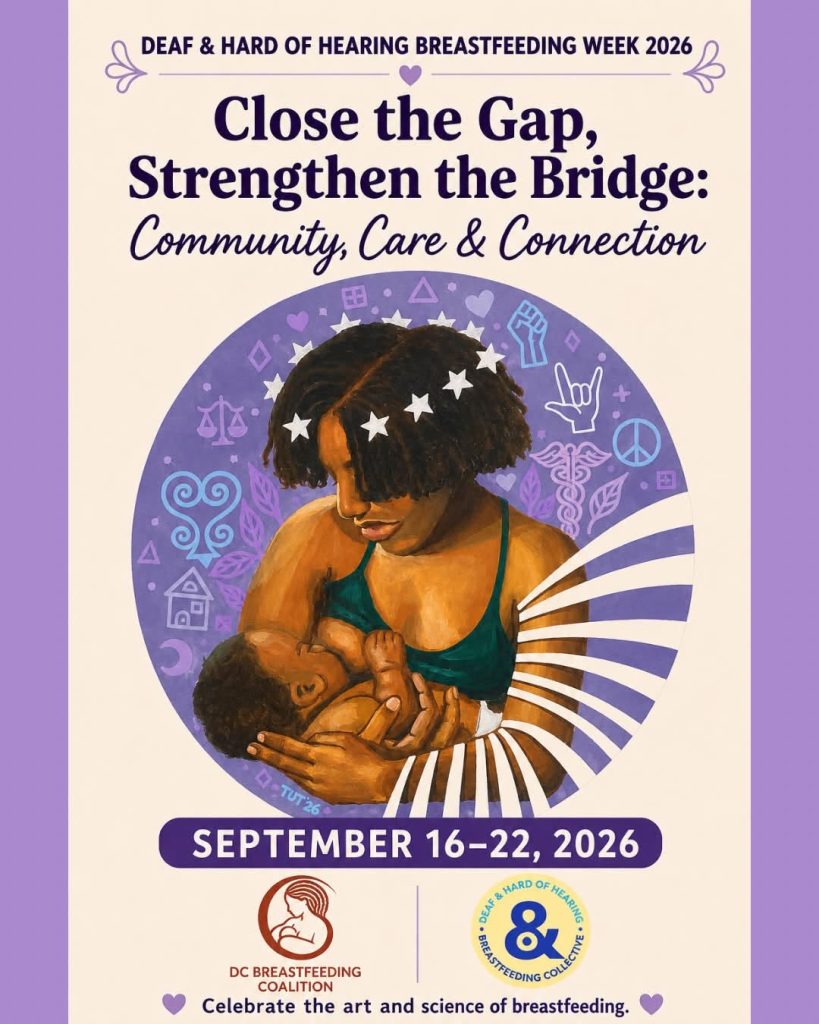
Members of the Deaf and Hard of Hearing Breastfeeding Collective (DHHBFC) are Deaf and hearing individuals with numerous backgrounds. The team includes a Deaf Certified Birth Doula and Apprentice Midwife, American Sign Language Teacher, Deaf American Sign Language Translator, Registered Nurse, International Board Certified Lactation Consultants, Certified Breastfeeding Specialists, Educators, Writers, Consultants, birth workers, and breastfeeding supporters. There are 11 individuals who make up the team, five of them are Deaf and six are hearing. Most of the hearing members are ASL users. The majority of the responses in this blog are from our Deaf members. When a response was specific to the Deaf community, only Deaf person(s) answered.
Could you tell us a little about the Deaf and Hard of Hearing Breastfeeding Collective and how it came to be?
In 2025, the DC Breastfeeding Coalition (DCBFC) led the charge to establish the first Deaf and Hard of Hearing Breastfeeding (DHHBF) Week. The purpose of this initiative is to provide the nation’s marginalized and underrepresented Deaf community with accessible breastfeeding education, support, and community, because language and breastfeeding access matters from birth!
Beginning in 2019, the DCBFC committed to increasing breastfeeding education, awareness, and support within the Deaf and Hard of Hearing (Deaf/HoH) Community. DCBFC began with providing breastfeeding education and support to Gallaudet University students and staff. Additionally, by employing certified American Sign Language (ASL) interpreters, the DCBFC educated Deaf/HoH individuals attending their nationally recognized Lactation Certification Preparation Course. By hiring a Deaf-owned production company, DCBFC was able to develop a series of ASL breastfeeding education videos that are culturally aligned. See videos here.
To go along with this year’s theme, the DHHBFC is committed to building Community based relationships through Connection. This plan will require listening with Care. Utilizing this approach renders the opportunity to respond with solution centered ideas based on the lived experiences of those most affected.
What does human milk feeding look like within the Deaf and Hard of Hearing Community?
Human milk feeding within the Deaf/HoH Community can look many different ways, just like it does for hearing families. Throughout their feeding journeys, Deaf/HoH parents may seek lactation support from lactation professionals, doulas, or peer supporters, as well as support from other Deaf/HoH parents and community members. Accessible and culturally responsive support may include ASL, visual demonstrations, captioned videos, and other visual resources that make breastfeeding and human milk information easier to understand and access. Technology can also play an important role through breast pumps, milk-storage systems, mobile apps, online educational videos with Deaf interpreters, and virtual Deaf/HoH parent communities. Together, these experiences demonstrate that human milk feeding in the Deaf/HoH community is diverse, adaptable, and strengthened by accessible information, technology, professional support, and community connection.
What are some of the unique experiences or challenges Deaf and Hard of Hearing parents may encounter when breastfeeding or seeking breastfeeding support?
In my experience with my first daughter, I told the nurse that breastfeeding was my goal. However, the staff did not seem sure how to provide me with appropriate breastfeeding support because communication access was not available. An interpreter was not provided, and I was asked to watch a hospital video about how to breastfeed a newborn, but it did not have any closed captions. I felt that I had to figure out much of the process on my own and do a lot of research independently.
I did not receive professional breastfeeding support until my daughter was about five or six months old, when I began experiencing pain. I sought help from a lactation professional, but during our first appointment, we had to communicate by writing back and forth. I was not satisfied with that experience.
During my second appointment, an interpreter was provided through a video screen. However, it was still very difficult to communicate. The lactation consultant needed to demonstrate techniques and explain things to me, but I could not easily see both her and the interpreter. At times, the consultant’s body blocked my view of the interpreter. As a Deaf person who relies on visual communication, I realized that this approach was not culturally or visually accessible to me.
When I had my second daughter, an in-person interpreter was provided. However, the lactation nurse did not seem to know how to work with us and appeared uncomfortable and awkward. Later, I met with a lactation consultant with an interpreter, and that experience was much better. It helped make my breastfeeding journey with my second daughter much more positive, although there were still limitations in communication and interpretation.
These experiences showed me how important it is for lactation consultants and healthcare professionals to receive proper training on how to work with and provide culturally responsive, accessible support to Deaf/HoH mothers.
One unique experience I can also think of is communicating while breastfeeding. Sometimes I needed to use one hand to sign while holding my baby with the other hand. Over time, I learned to adjust my breastfeeding position and use supportive tools and pillows so that my baby was safely supported and I could have both hands available to communicate.
Even when a parent is fortunate enough to have access to an ASL interpreter, the interpreter may have limited familiarity with lactation terminology, breastfeeding practices, or the specialized classifiers used during a lactation consultation. This can potentially affect the accuracy and clarity of communication and, ultimately, the parent’s understanding of their care.
Unfortunately, Deaf parents are often not provided with an interpreter at all for lactation appointments. As a result, they may be left to communicate through writing, gestures, pictures, videos, or other methods that may not fully support clear, detailed, and individualized communication. These barriers can be frustrating and discouraging and may contribute to some members of the Deaf/HoH community choosing not to seek breastfeeding support at all.
How has communication—or lack of accessible communication—affected the experiences of the Deaf/HoH community with healthcare providers, lactation professionals, or other sources of breastfeeding support?
Lack of accessible communication can make healthcare and breastfeeding support very difficult for Deaf/HoH parents. Without qualified ASL interpreters or other effective communication, we can miss important information and feel excluded from decisions about our own health and our baby’s care.
Communication access is essential, not optional. Deaf/HoH parents deserve to be heard, understood, and included just like everyone else.
For a Deaf parent, hands are language. In a postpartum recovery room, a nurse or lactation consultant leans in to help with latch, and the parent’s hands are full with the baby. They begin explaining and touching at the same time. The baby is fussy and crying, so they start manually supporting the latch instead of explaining the mechanics. Lipreading is not possible when everyone is looking down at the baby, in a dim room, at three in the morning, after twenty hours of labor.
If the family had an onsite interpreter for the birth, that interpreter has usually already left. What remains is a VRI cart, if available — a video remote interpreting cart with an iPad-sized screen parked five feet from the bed where a reclining parent cannot see it, angled at the ceiling, or frozen, and no one adjusts it for a reclining parent. Or a family member who may know no more about breastfeeding than the parent does. In this case, the parent gets a summary, not the full details. That is the exact moment the teaching should happen, and that is the exact moment access disappears.
It is also, for many first-time Deaf parents, the only moment. Prenatal breastfeeding education is frequently missing altogether, so this bedside encounter is their first and last exposure to lactation instruction.
Too often, Deaf families leave the hospital with far less information than hearing families do. Nobody has explained hand expression, the baby’s stomach size, or colostrum. Nobody has described what engorgement feels like, what a good latch versus a painful latch means, or when and who to call for help.
The result is not a milk problem. It is an information problem that gets recorded as a milk problem. Parents are labeled quiet, or non-compliant, or “not interested in breastfeeding,” when what actually happened is that no one gave them the information in a language they could receive. Cultural fluency matters here as much as linguistic fluency — serving Deaf families well requires both.
What kinds of support have been especially meaningful or helpful to Deaf and Hard of Hearing breastfeeding families?
We deserve support that meets our needs; not support that expects us to adjust or constantly advocate for ourselves. ASL and accessible communication play a very important role in making breastfeeding support more inclusive and effective for Deaf/HoH parents. What has been most meaningful is having providers who truly listen, respect our choices, and take the time to understand our communication needs. Access to qualified ASL interpreters or other effective communication, Deaf/HoH peer support, and visual resources can make a huge difference. It would be wonderful to have more Deaf/HoH, or signing lactation consultants who understand how to work with Deaf mothers and their babies.
Healthcare and lactation professionals also need to be culturally sensitive and understand that Deaf people are visual communicators. This means that they need to know how to effectively work with ASL interpreters. When demonstrating techniques such as proper latching, positioning, or using breastfeeding tools, providers should think carefully about how they position themselves to deliver visual information so that the parent can clearly see both the demonstration and the interpreter, if one is present.
Interpreters who work in breastfeeding and healthcare settings should have knowledge of breastfeeding-related terminology so they can interpret information as accurately and clearly as possible. All educational materials, including videos, should be accessible through closed captions or subtitles. Breastfeeding information should also be provided in clear and simple language.
The support that changes outcomes is direct — language to language. Where direct access is not possible, the alternatives are not equivalent, and it is worth being precise about the access hierarchy. The best option is a Deaf lactation provider signing directly with a Deaf parent; native ASL users are the strongest fit for this work. Next is a hearing lactation provider fluent in ASL, working directly. When neither is available — and today they usually are not, because there are simply not enough ASL-using lactation providers in the United States — the standard is a qualified ASL interpreter, in person, for the full visit. A qualified interpreter appearing virtually is a last resort, and it should be named as what it is: not high-quality lactation support. A family member should be used only when the Deaf parent and the family member both agree to it, and it should never be the original or cost-effective plan.
One thing that is often misunderstood: a hearing provider who knows a little sign still needs a qualified interpreter, exactly like a provider who knows none. Partial fluency does not close the gap; it just makes the gap harder to see.
The most meaningful thing a lactation professional has ever done for my clients is book a qualified interpreter for the full visit, in advance, without the family having to advocate for it while sore, leaking breastmilk, and exhausted. When a Deaf parent can ask a question in their own language, without scheduling an interpreter first, they ask more questions. In my experience that shows up as more milk, more confidence, and fewer early weans — the same way it does for hearing parents.
Peer community is also important. A pregnant Deaf parent watching another Deaf parent nurse a baby — and sign about the hard parts — does something no pamphlet or video can do. Deaf parents supporting Deaf parents is its own intervention.
Visual teaching is necessary. If you’re a healthcare provider for Deaf/HoH parents, explain first. Then show. Then pause and explain again. Do not show and explain at the same time — a Deaf parent cannot watch your hands on the baby and read your signed or interpreted explanation simultaneously. Use a mirror, a doll, your own hands, a marked-up handout with clear visuals the parent can keep. Position yourself where the parent can see your face and your hands at the same time. Stop the hands-on help so the parent can respond. Pause for eye contact often enough to confirm the parent is following, rather than assuming they are.
We need more Deaf/HoH lactation professionals, and the shortage is the root cause underneath everything else in this answer. Every interpreter booking, every VRI cart, every workaround in this piece exists because a Deaf parent could not simply talk to a provider who signs. Growing the number of Deaf/HoH professionals who can serve Deaf/HoH families directly, in their own language, is the only fix that removes the middle layer instead of managing it. The National Deaf and Hard of Hearing Breastfeeding Collective is awarding scholarship seats in lactation training for Deaf/HoH applicants for exactly this reason. Every professional we train removes a middle layer for a whole community.
No parent and baby who desire to breastfeed should be left to navigate their journey without appropriate support simply because the parent communicates in a different language than the services being offered. Ensuring accessible, inclusive, and ASL-centered lactation support is not only important — it is essential to providing equitable care and ensuring that all families have the opportunity to receive the support they need.
Are there any misconceptions you wish healthcare providers, lactation professionals, or the general public understood better about Deaf and Hard of Hearing parents and breastfeeding?
One of the biggest misconceptions is that being Deaf or Hard of Hearing creates a barrier to breastfeeding. Deaf/HoH parents are fully capable of breastfeeding and making informed decisions about infant feeding. What often creates the barrier is the lack of accessible, culturally, and linguistically appropriate information and support.
Healthcare providers and lactation professionals should ask each parent what communication method works best for them, rather than making assumptions based on hearing status.
Another misconception is that Deaf parents need to be “fixed” or treated differently because they are Deaf. What they need is equitable access to the same quality of prenatal, postpartum, and lactation support available to hearing parents. When communication access, culturally responsive care, and community support are available, Deaf/HoH parents can thrive in their breastfeeding journeys.
What strengths or unique perspectives do Deaf and Hard of Hearing parents bring to their breastfeeding experiences and communities?
I feel that members of the Deaf/HoH Community have the special ability to sense and read body language. Often this is because there is a lack of and/or lower percentage of functionality (hearing level), which makes the other senses sharper. This can become an advantage as visual cues are helpful with catching things that might have been missed. Also, it makes it easier to describe things visually!
Deaf/HoH parents bring tremendous strengths to their breastfeeding experiences, including resilience, self-advocacy, visual communication, creativity, and strong community connections. ASL also offers a unique visual way of learning and communicating about breastfeeding, including positioning, latching, pumping, and other techniques. Deaf culture often emphasizes sharing information and supporting one another, which can create valuable peer networks for new parents.
Many Deaf parents are also highly resourceful in using technology and social media to find information and connect with other parents.
One of the most powerful perspectives is the understanding of breastfeeding as a journey that may involve challenges, learning, persistence, and problem-solving. Rather than viewing Deaf parents through a deficit lens, healthcare and lactation professionals should recognize the strengths that Deaf communities already bring and build upon them. Ultimately, Deaf/HoH parents should not simply be viewed as recipients of support. They are also knowledge holders, advocates, mentors, and leaders within their communities.
What would you like a Deaf/HoH parent who is considering breastfeeding to know—that they might not hear from mainstream breastfeeding resources?
Social media can be a helpful place to learn and connect, but the advice may not apply to your specific situation, your baby, or your communication needs. Everyone deserves individualized support that meets their family’s unique needs. The Deaf and Hard of Hearing Breastfeeding Collective was created to help you find Deaf and ASL friendly providers who understand the importance of accessible, individualized care.
I would want Deaf/HoH parents to know that they deserve access to breastfeeding education and support that is designed with them in mind. I would also want parents to know that they are not alone. Connecting with other Deaf/HoH parents can provide encouragement, practical knowledge, and a sense of community. Breastfeeding may have its challenges, but being Deaf/HoH should never be viewed as a reason why a parent doesn’t breastfeed.
What changes would you most like to see in breastfeeding support and healthcare to make services more accessible to Deaf and Hard of Hearing families?
The number one change I would like to see is having qualified ASL interpreters readily available for lactation support in hospitals and healthcare settings—not only during labor and delivery. Deaf/HoH mothers need accessible communication throughout their entire breastfeeding journey, including after the baby is born, during lactation consultations, and at follow-up appointments.
I would also like to see more training for lactation consultants, nurses, and other healthcare professionals on ways to work effectively with Deaf/HoH families. This training should include communication accessibility, Deaf culture, cultural sensitivity, and practical strategies for providing visual and accessible breastfeeding support.
Another important change would be to see ASL interpreters booked by default, matched to the modality of the visit. If the appointment is in person; the interpreter is in person. An interpreter appearing on a screen while hands-on lactation support happens in the room is ineffective — the parent cannot watch the screen and the latch at once. Video is appropriate when the lactation support itself is virtual, and a Deaf parent signing directly with an ASL-using provider works well in either format. This applies to prenatal visits where breastfeeding is discussed, to first latch support after birth, and to every lactation consult, home visit, and follow up appointment. Access should not depend on whether a postpartum parent has the energy to fight for it.
A real funding obstacle for interpreter access in private practice is the structural gap most people never see. An IBCLC in solo practice is legally responsible for providing access, but interpreter costs routinely exceed what the visit itself pays. Until there is reimbursement, a dedicated interpreter fund, or grant support, small lactation practices will keep quietly turning Deaf families away — not out of hostility, but because the math does not work. Investment in Deaf/HoH lactation professionals whose primary language is ASL is crucial — scholarships, mentorships, and clinical pathways to IBCLC and CLC credentials.
Another helpful change would be to see communication preferences documented in the patient chart and honored at every shift change. English is a second language for many Deaf parents. Information delivered only in written English is not equal information. A note reading “Deaf, uses ASL, interpreter required” should follow the family from triage to discharge to the follow-up call.
Deaf/HoH people must be in the room where decisions are made — on advisory boards, in IBCLC and CLC training curricula, in hospital policy, and in La Leche League leadership. Nothing about us without us.
What is one thing you wish hearing breastfeeding supporters understood about your community?
I wish hearing breastfeeding supporters understood that Deaf/HoH families are capable and knowledgeable parents—we just need communication access. Please don’t make assumptions about what we can or cannot do. Listen to us, respect our choices, and provide the communication and support we need.
I wish that hearing breastfeeding supporters understood how significant accessibility is to our community. Even the smallest accommodation would help greatly!
We are not a hard-to-reach population. We are an unreached one, and those are two very different things.
Deaf parents want to breastfeed at the same rates as anyone else. What stops them is rarely their bodies. It is being handed a phone number instead of a video option. It is being asked to bring their own interpreter — a cost and a responsibility the ADA places on the provider, not the parent. It is being talked about in the third person while sitting right there. It is being told that a lactation consultant “isn’t set up for that.”
Sometimes the Deaf parent is expected to teach the lactation specialist how to work with an interpreter, during a visit they are paying for by the hour. And even when an interpreter is present, no one lengthens the appointment. Language and cultural mediation take time to do well. If the visit stays the same length, the Deaf parent receives less information than the hearing parent in the next room — or absorbs the cost by paying for the extra time themselves. Neither is equal access.
None of this is a lactation problem. It is an access problem, and it is fixable. Being Deaf does not affect breastmilk. Barriers do.
If you are a hearing supporter, you do not need to become fluent in ASL to change that. What helps is arranging access for Deaf parents, learning to face the parent instead of the interpreter, and to work with an interpreter well enough that the visit is spent connecting with the parent, rather than troubleshooting the interpretation. One sentence, “I’ll arrange the interpreter before your appointment,” has kept more Deaf families breastfeeding than any nursing technique I know.
Throughout the week, the Collective will share stories from breastfeeding families and educational resources. In partnership with Lactation Education Resources and Parenthood Encompassed, the Deaf and Hard of Hearing Breastfeeding Collective will award up to five Certified Breastfeeding Specialist scholarships for Deaf individuals. There is more, much more! Stay tuned, you don’t want to miss the opportunity to improve your ability to connect with the Deaf/HoH community.
Supporting Breastfeeding Families–Today, Tomorrow, Always
Please consider donating to La Leche League USA.
Your gift helps support this blog and the website!
Donations of any amount are gratefully accepted. Thank you!
Follow us on:


Leave a Comment
Posted: September 8, 2026 by Yael Breimer
Celebrating Deaf and Hard of Hearing Breastfeeding Week
by Deaf and Hard of Hearing Breastfeeding Collective
Editor’s note: This year marks the second annual Deaf and Hard of Hearing Breastfeeding (DHHBF) Week, from September 16–22. This year’s theme, Close the Gap, Strengthen the Bridge: Community, Care & Connection seeks to underscore the importance of improving breastfeeding outcomes in the Deaf and Hard of Hearing (Deaf/HoH) Community. Read on for an interview between New Beginnings and the Deaf and Hard of Hearing Breastfeeding Collective (DHHBFC). Learn more through the DHHBFC Facebook page or Instagram.
Members of the Deaf and Hard of Hearing Breastfeeding Collective (DHHBFC) are Deaf and hearing individuals with numerous backgrounds. The team includes a Deaf Certified Birth Doula and Apprentice Midwife, American Sign Language Teacher, Deaf American Sign Language Translator, Registered Nurse, International Board Certified Lactation Consultants, Certified Breastfeeding Specialists, Educators, Writers, Consultants, birth workers, and breastfeeding supporters. There are 11 individuals who make up the team, five of them are Deaf and six are hearing. Most of the hearing members are ASL users. The majority of the responses in this blog are from our Deaf members. When a response was specific to the Deaf community, only Deaf person(s) answered.
Could you tell us a little about the Deaf and Hard of Hearing Breastfeeding Collective and how it came to be?
In 2025, the DC Breastfeeding Coalition (DCBFC) led the charge to establish the first Deaf and Hard of Hearing Breastfeeding (DHHBF) Week. The purpose of this initiative is to provide the nation’s marginalized and underrepresented Deaf community with accessible breastfeeding education, support, and community, because language and breastfeeding access matters from birth!
Beginning in 2019, the DCBFC committed to increasing breastfeeding education, awareness, and support within the Deaf and Hard of Hearing (Deaf/HoH) Community. DCBFC began with providing breastfeeding education and support to Gallaudet University students and staff. Additionally, by employing certified American Sign Language (ASL) interpreters, the DCBFC educated Deaf/HoH individuals attending their nationally recognized Lactation Certification Preparation Course. By hiring a Deaf-owned production company, DCBFC was able to develop a series of ASL breastfeeding education videos that are culturally aligned. See videos here.
To go along with this year’s theme, the DHHBFC is committed to building Community based relationships through Connection. This plan will require listening with Care. Utilizing this approach renders the opportunity to respond with solution centered ideas based on the lived experiences of those most affected.
What does human milk feeding look like within the Deaf and Hard of Hearing Community?
Human milk feeding within the Deaf/HoH Community can look many different ways, just like it does for hearing families. Throughout their feeding journeys, Deaf/HoH parents may seek lactation support from lactation professionals, doulas, or peer supporters, as well as support from other Deaf/HoH parents and community members. Accessible and culturally responsive support may include ASL, visual demonstrations, captioned videos, and other visual resources that make breastfeeding and human milk information easier to understand and access. Technology can also play an important role through breast pumps, milk-storage systems, mobile apps, online educational videos with Deaf interpreters, and virtual Deaf/HoH parent communities. Together, these experiences demonstrate that human milk feeding in the Deaf/HoH community is diverse, adaptable, and strengthened by accessible information, technology, professional support, and community connection.
What are some of the unique experiences or challenges Deaf and Hard of Hearing parents may encounter when breastfeeding or seeking breastfeeding support?
In my experience with my first daughter, I told the nurse that breastfeeding was my goal. However, the staff did not seem sure how to provide me with appropriate breastfeeding support because communication access was not available. An interpreter was not provided, and I was asked to watch a hospital video about how to breastfeed a newborn, but it did not have any closed captions. I felt that I had to figure out much of the process on my own and do a lot of research independently.
I did not receive professional breastfeeding support until my daughter was about five or six months old, when I began experiencing pain. I sought help from a lactation professional, but during our first appointment, we had to communicate by writing back and forth. I was not satisfied with that experience.
During my second appointment, an interpreter was provided through a video screen. However, it was still very difficult to communicate. The lactation consultant needed to demonstrate techniques and explain things to me, but I could not easily see both her and the interpreter. At times, the consultant’s body blocked my view of the interpreter. As a Deaf person who relies on visual communication, I realized that this approach was not culturally or visually accessible to me.
When I had my second daughter, an in-person interpreter was provided. However, the lactation nurse did not seem to know how to work with us and appeared uncomfortable and awkward. Later, I met with a lactation consultant with an interpreter, and that experience was much better. It helped make my breastfeeding journey with my second daughter much more positive, although there were still limitations in communication and interpretation.
These experiences showed me how important it is for lactation consultants and healthcare professionals to receive proper training on how to work with and provide culturally responsive, accessible support to Deaf/HoH mothers.
One unique experience I can also think of is communicating while breastfeeding. Sometimes I needed to use one hand to sign while holding my baby with the other hand. Over time, I learned to adjust my breastfeeding position and use supportive tools and pillows so that my baby was safely supported and I could have both hands available to communicate.
Even when a parent is fortunate enough to have access to an ASL interpreter, the interpreter may have limited familiarity with lactation terminology, breastfeeding practices, or the specialized classifiers used during a lactation consultation. This can potentially affect the accuracy and clarity of communication and, ultimately, the parent’s understanding of their care.
Unfortunately, Deaf parents are often not provided with an interpreter at all for lactation appointments. As a result, they may be left to communicate through writing, gestures, pictures, videos, or other methods that may not fully support clear, detailed, and individualized communication. These barriers can be frustrating and discouraging and may contribute to some members of the Deaf/HoH community choosing not to seek breastfeeding support at all.
How has communication—or lack of accessible communication—affected the experiences of the Deaf/HoH community with healthcare providers, lactation professionals, or other sources of breastfeeding support?
Lack of accessible communication can make healthcare and breastfeeding support very difficult for Deaf/HoH parents. Without qualified ASL interpreters or other effective communication, we can miss important information and feel excluded from decisions about our own health and our baby’s care.
Communication access is essential, not optional. Deaf/HoH parents deserve to be heard, understood, and included just like everyone else.
For a Deaf parent, hands are language. In a postpartum recovery room, a nurse or lactation consultant leans in to help with latch, and the parent’s hands are full with the baby. They begin explaining and touching at the same time. The baby is fussy and crying, so they start manually supporting the latch instead of explaining the mechanics. Lipreading is not possible when everyone is looking down at the baby, in a dim room, at three in the morning, after twenty hours of labor.
If the family had an onsite interpreter for the birth, that interpreter has usually already left. What remains is a VRI cart, if available — a video remote interpreting cart with an iPad-sized screen parked five feet from the bed where a reclining parent cannot see it, angled at the ceiling, or frozen, and no one adjusts it for a reclining parent. Or a family member who may know no more about breastfeeding than the parent does. In this case, the parent gets a summary, not the full details. That is the exact moment the teaching should happen, and that is the exact moment access disappears.
It is also, for many first-time Deaf parents, the only moment. Prenatal breastfeeding education is frequently missing altogether, so this bedside encounter is their first and last exposure to lactation instruction.
Too often, Deaf families leave the hospital with far less information than hearing families do. Nobody has explained hand expression, the baby’s stomach size, or colostrum. Nobody has described what engorgement feels like, what a good latch versus a painful latch means, or when and who to call for help.
The result is not a milk problem. It is an information problem that gets recorded as a milk problem. Parents are labeled quiet, or non-compliant, or “not interested in breastfeeding,” when what actually happened is that no one gave them the information in a language they could receive. Cultural fluency matters here as much as linguistic fluency — serving Deaf families well requires both.
What kinds of support have been especially meaningful or helpful to Deaf and Hard of Hearing breastfeeding families?
We deserve support that meets our needs; not support that expects us to adjust or constantly advocate for ourselves. ASL and accessible communication play a very important role in making breastfeeding support more inclusive and effective for Deaf/HoH parents. What has been most meaningful is having providers who truly listen, respect our choices, and take the time to understand our communication needs. Access to qualified ASL interpreters or other effective communication, Deaf/HoH peer support, and visual resources can make a huge difference. It would be wonderful to have more Deaf/HoH, or signing lactation consultants who understand how to work with Deaf mothers and their babies.
Healthcare and lactation professionals also need to be culturally sensitive and understand that Deaf people are visual communicators. This means that they need to know how to effectively work with ASL interpreters. When demonstrating techniques such as proper latching, positioning, or using breastfeeding tools, providers should think carefully about how they position themselves to deliver visual information so that the parent can clearly see both the demonstration and the interpreter, if one is present.
Interpreters who work in breastfeeding and healthcare settings should have knowledge of breastfeeding-related terminology so they can interpret information as accurately and clearly as possible. All educational materials, including videos, should be accessible through closed captions or subtitles. Breastfeeding information should also be provided in clear and simple language.
The support that changes outcomes is direct — language to language. Where direct access is not possible, the alternatives are not equivalent, and it is worth being precise about the access hierarchy. The best option is a Deaf lactation provider signing directly with a Deaf parent; native ASL users are the strongest fit for this work. Next is a hearing lactation provider fluent in ASL, working directly. When neither is available — and today they usually are not, because there are simply not enough ASL-using lactation providers in the United States — the standard is a qualified ASL interpreter, in person, for the full visit. A qualified interpreter appearing virtually is a last resort, and it should be named as what it is: not high-quality lactation support. A family member should be used only when the Deaf parent and the family member both agree to it, and it should never be the original or cost-effective plan.
One thing that is often misunderstood: a hearing provider who knows a little sign still needs a qualified interpreter, exactly like a provider who knows none. Partial fluency does not close the gap; it just makes the gap harder to see.
The most meaningful thing a lactation professional has ever done for my clients is book a qualified interpreter for the full visit, in advance, without the family having to advocate for it while sore, leaking breastmilk, and exhausted. When a Deaf parent can ask a question in their own language, without scheduling an interpreter first, they ask more questions. In my experience that shows up as more milk, more confidence, and fewer early weans — the same way it does for hearing parents.
Peer community is also important. A pregnant Deaf parent watching another Deaf parent nurse a baby — and sign about the hard parts — does something no pamphlet or video can do. Deaf parents supporting Deaf parents is its own intervention.
Visual teaching is necessary. If you’re a healthcare provider for Deaf/HoH parents, explain first. Then show. Then pause and explain again. Do not show and explain at the same time — a Deaf parent cannot watch your hands on the baby and read your signed or interpreted explanation simultaneously. Use a mirror, a doll, your own hands, a marked-up handout with clear visuals the parent can keep. Position yourself where the parent can see your face and your hands at the same time. Stop the hands-on help so the parent can respond. Pause for eye contact often enough to confirm the parent is following, rather than assuming they are.
We need more Deaf/HoH lactation professionals, and the shortage is the root cause underneath everything else in this answer. Every interpreter booking, every VRI cart, every workaround in this piece exists because a Deaf parent could not simply talk to a provider who signs. Growing the number of Deaf/HoH professionals who can serve Deaf/HoH families directly, in their own language, is the only fix that removes the middle layer instead of managing it. The National Deaf and Hard of Hearing Breastfeeding Collective is awarding scholarship seats in lactation training for Deaf/HoH applicants for exactly this reason. Every professional we train removes a middle layer for a whole community.
No parent and baby who desire to breastfeed should be left to navigate their journey without appropriate support simply because the parent communicates in a different language than the services being offered. Ensuring accessible, inclusive, and ASL-centered lactation support is not only important — it is essential to providing equitable care and ensuring that all families have the opportunity to receive the support they need.
Are there any misconceptions you wish healthcare providers, lactation professionals, or the general public understood better about Deaf and Hard of Hearing parents and breastfeeding?
One of the biggest misconceptions is that being Deaf or Hard of Hearing creates a barrier to breastfeeding. Deaf/HoH parents are fully capable of breastfeeding and making informed decisions about infant feeding. What often creates the barrier is the lack of accessible, culturally, and linguistically appropriate information and support.
Healthcare providers and lactation professionals should ask each parent what communication method works best for them, rather than making assumptions based on hearing status.
Another misconception is that Deaf parents need to be “fixed” or treated differently because they are Deaf. What they need is equitable access to the same quality of prenatal, postpartum, and lactation support available to hearing parents. When communication access, culturally responsive care, and community support are available, Deaf/HoH parents can thrive in their breastfeeding journeys.
What strengths or unique perspectives do Deaf and Hard of Hearing parents bring to their breastfeeding experiences and communities?
I feel that members of the Deaf/HoH Community have the special ability to sense and read body language. Often this is because there is a lack of and/or lower percentage of functionality (hearing level), which makes the other senses sharper. This can become an advantage as visual cues are helpful with catching things that might have been missed. Also, it makes it easier to describe things visually!
Deaf/HoH parents bring tremendous strengths to their breastfeeding experiences, including resilience, self-advocacy, visual communication, creativity, and strong community connections. ASL also offers a unique visual way of learning and communicating about breastfeeding, including positioning, latching, pumping, and other techniques. Deaf culture often emphasizes sharing information and supporting one another, which can create valuable peer networks for new parents.
Many Deaf parents are also highly resourceful in using technology and social media to find information and connect with other parents.
One of the most powerful perspectives is the understanding of breastfeeding as a journey that may involve challenges, learning, persistence, and problem-solving. Rather than viewing Deaf parents through a deficit lens, healthcare and lactation professionals should recognize the strengths that Deaf communities already bring and build upon them. Ultimately, Deaf/HoH parents should not simply be viewed as recipients of support. They are also knowledge holders, advocates, mentors, and leaders within their communities.
What would you like a Deaf/HoH parent who is considering breastfeeding to know—that they might not hear from mainstream breastfeeding resources?
Social media can be a helpful place to learn and connect, but the advice may not apply to your specific situation, your baby, or your communication needs. Everyone deserves individualized support that meets their family’s unique needs. The Deaf and Hard of Hearing Breastfeeding Collective was created to help you find Deaf and ASL friendly providers who understand the importance of accessible, individualized care.
I would want Deaf/HoH parents to know that they deserve access to breastfeeding education and support that is designed with them in mind. I would also want parents to know that they are not alone. Connecting with other Deaf/HoH parents can provide encouragement, practical knowledge, and a sense of community. Breastfeeding may have its challenges, but being Deaf/HoH should never be viewed as a reason why a parent doesn’t breastfeed.
What changes would you most like to see in breastfeeding support and healthcare to make services more accessible to Deaf and Hard of Hearing families?
The number one change I would like to see is having qualified ASL interpreters readily available for lactation support in hospitals and healthcare settings—not only during labor and delivery. Deaf/HoH mothers need accessible communication throughout their entire breastfeeding journey, including after the baby is born, during lactation consultations, and at follow-up appointments.
I would also like to see more training for lactation consultants, nurses, and other healthcare professionals on ways to work effectively with Deaf/HoH families. This training should include communication accessibility, Deaf culture, cultural sensitivity, and practical strategies for providing visual and accessible breastfeeding support.
Another important change would be to see ASL interpreters booked by default, matched to the modality of the visit. If the appointment is in person; the interpreter is in person. An interpreter appearing on a screen while hands-on lactation support happens in the room is ineffective — the parent cannot watch the screen and the latch at once. Video is appropriate when the lactation support itself is virtual, and a Deaf parent signing directly with an ASL-using provider works well in either format. This applies to prenatal visits where breastfeeding is discussed, to first latch support after birth, and to every lactation consult, home visit, and follow up appointment. Access should not depend on whether a postpartum parent has the energy to fight for it.
A real funding obstacle for interpreter access in private practice is the structural gap most people never see. An IBCLC in solo practice is legally responsible for providing access, but interpreter costs routinely exceed what the visit itself pays. Until there is reimbursement, a dedicated interpreter fund, or grant support, small lactation practices will keep quietly turning Deaf families away — not out of hostility, but because the math does not work. Investment in Deaf/HoH lactation professionals whose primary language is ASL is crucial — scholarships, mentorships, and clinical pathways to IBCLC and CLC credentials.
Another helpful change would be to see communication preferences documented in the patient chart and honored at every shift change. English is a second language for many Deaf parents. Information delivered only in written English is not equal information. A note reading “Deaf, uses ASL, interpreter required” should follow the family from triage to discharge to the follow-up call.
Deaf/HoH people must be in the room where decisions are made — on advisory boards, in IBCLC and CLC training curricula, in hospital policy, and in La Leche League leadership. Nothing about us without us.
What is one thing you wish hearing breastfeeding supporters understood about your community?
I wish hearing breastfeeding supporters understood that Deaf/HoH families are capable and knowledgeable parents—we just need communication access. Please don’t make assumptions about what we can or cannot do. Listen to us, respect our choices, and provide the communication and support we need.
I wish that hearing breastfeeding supporters understood how significant accessibility is to our community. Even the smallest accommodation would help greatly!
We are not a hard-to-reach population. We are an unreached one, and those are two very different things.
Deaf parents want to breastfeed at the same rates as anyone else. What stops them is rarely their bodies. It is being handed a phone number instead of a video option. It is being asked to bring their own interpreter — a cost and a responsibility the ADA places on the provider, not the parent. It is being talked about in the third person while sitting right there. It is being told that a lactation consultant “isn’t set up for that.”
Sometimes the Deaf parent is expected to teach the lactation specialist how to work with an interpreter, during a visit they are paying for by the hour. And even when an interpreter is present, no one lengthens the appointment. Language and cultural mediation take time to do well. If the visit stays the same length, the Deaf parent receives less information than the hearing parent in the next room — or absorbs the cost by paying for the extra time themselves. Neither is equal access.
None of this is a lactation problem. It is an access problem, and it is fixable. Being Deaf does not affect breastmilk. Barriers do.
If you are a hearing supporter, you do not need to become fluent in ASL to change that. What helps is arranging access for Deaf parents, learning to face the parent instead of the interpreter, and to work with an interpreter well enough that the visit is spent connecting with the parent, rather than troubleshooting the interpretation. One sentence, “I’ll arrange the interpreter before your appointment,” has kept more Deaf families breastfeeding than any nursing technique I know.
Throughout the week, the Collective will share stories from breastfeeding families and educational resources. In partnership with Lactation Education Resources and Parenthood Encompassed, the Deaf and Hard of Hearing Breastfeeding Collective will award up to five Certified Breastfeeding Specialist scholarships for Deaf individuals. There is more, much more! Stay tuned, you don’t want to miss the opportunity to improve your ability to connect with the Deaf/HoH community.
Supporting Breastfeeding Families–Today, Tomorrow, Always
Please consider donating to La Leche League USA.
Your gift helps support this blog and the website!
Donations of any amount are gratefully accepted. Thank you!
Follow us on:
Facebook
Instagram
Category: Deaf and Hard of Hearing Breastfeeding Week
Subscribe to Our Blog
Upcoming events:
La Leche League Meetings