By Julienne D.
Editor’s Note: Indigenous Milk Medicine Week is celebrated annually from August 8-14. This year’s theme is “We Keep the Fires Lit: Rising Through Milk Medicine.” You can learn more about the 2026 Indigenous Milk Medicine Week on this website.
I am a Cree, Ojibway, and Mi’kmaq artist. I am from Membertou First Nation, Nova Scotia. I raise my family in Rocky Boy Reservation where my husband is from. I provide services as an Indigenous birthworker, lactation supporter, and maternal mental health advocate. I am the founder of Morningstar Workz, where I combine Indigenous art, teachings, and birthwork to support families throughout pregnancy. My work is rooted in the belief that birth is ceremony and that every family deserves care that honors their identity, traditions, and community.
My journey into birthwork grew from both personal experience and a desire to address the disparities Indigenous families continue to face within healthcare systems. As I became involved in supporting breastfeeding and infant feeding, I realized that many families wanted culturally relevant education that reflected their own experiences and values. Supporting lactation is not simply about nutrition for a baby — it is about rebuilding confidence, strengthening family bonds, reclaiming Indigenous knowledge, and helping parents feel empowered in their roles as caregivers.
Art became one of the most meaningful ways for me to share these teachings. Ever since my teen years, I have been asked to also do memorial art work for families, in commemoration of their loved ones. My practices have been on both spectrums of life and when relatives journey on. So in many ways, my art reaches people emotionally in ways that words alone often cannot. It creates opportunities for conversation, healing, and reflection, while making changes more approachable when the subject gets tough, especially when it involves grief, whether for an unborn baby or an elder.
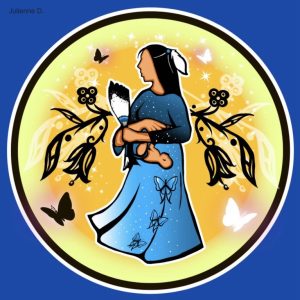 Many of my pieces feature Indigenous mothers, babies, grandmothers, plants, flowers, medicines, and celestial imagery. One recurring symbol is the pregnant woman surrounded by prairie roses and cedar. The rose represents love, resilience, beauty, and the strength of Indigenous women. Cedar symbolizes protection, healing, prayer, and purification. I often use circular compositions, because circles represent the cycles of life, the seasons, the family, and the interconnectedness of all living beings.
My cultural identity influences every part of my artistic process. I approach each piece with respect, prayer, and an understanding that our teachings are living knowledge carried through generations. Rather than creating art solely for decoration, I see each piece as a teaching tool that reflects Indigenous values of balance, kinship, community, and reciprocity. I hope viewers see themselves reflected in the work and feel a sense of belonging and healing. For Indigenous families especially, I want them to recognize that our ways of caring for mothers and babies remain powerful and relevant today.
The phrase “Milk Medicine” holds deep meaning for me. Breastmilk is more than nourishment; it is our first food and medicine. It carries comfort, immunity, protection, connection, and love. Milk Medicine represents the sacred relationship between parent and child and the continuation of life through nurturing. It reminds us that feeding a baby is both a physical act and a spiritual responsibility that strengthens families and communities.
Breastfeeding has always been connected to Indigenous traditions and ways of knowing. Before colonization, infant feeding was supported collectively by families, grandmothers, aunties, and community members. Children were raised within a circle of care where nurturing was everyone’s responsibility. Colonization, forced assimilation, residential schools, and disruptions to family structures interrupted many of these teachings. Today, supporting breastfeeding is also part of reclaiming Indigenous knowledge and restoring confidence in our traditional parenting practices.
Art has the power to preserve generational thoughts, teachings, and stories. A painting or illustration can spark conversations between Elders and youth, create culturally meaningful educational materials for clinics and schools, and remind Indigenous families that our knowledge systems are alive. Through visual storytelling, we honor our ancestors while creating new pathways for healing and wellness. My hope is that every piece I create contributes to the reclamation of Indigenous birth traditions, strengthens community connections, and reminds families that nurturing our children is one of the most powerful forms of medicine we carry within us.
Supporting Breastfeeding Families–Today, Tomorrow, Always
Please consider donating to La Leche League USA.
Your gift helps support this blog and the website!
Donations of any amount are gratefully accepted. Thank you!
Follow us on:

Leave a Comment
Posted: August 4, 2026 by Yael Breimer
Indigenous Milk Medicine Week: Julianne’s Artwork
By Julienne D.
Editor’s Note: Indigenous Milk Medicine Week is celebrated annually from August 8-14. This year’s theme is “We Keep the Fires Lit: Rising Through Milk Medicine.” You can learn more about the 2026 Indigenous Milk Medicine Week on this website.
I am a Cree, Ojibway, and Mi’kmaq artist. I am from Membertou First Nation, Nova Scotia. I raise my family in Rocky Boy Reservation where my husband is from. I provide services as an Indigenous birthworker, lactation supporter, and maternal mental health advocate. I am the founder of Morningstar Workz, where I combine Indigenous art, teachings, and birthwork to support families throughout pregnancy. My work is rooted in the belief that birth is ceremony and that every family deserves care that honors their identity, traditions, and community.
My journey into birthwork grew from both personal experience and a desire to address the disparities Indigenous families continue to face within healthcare systems. As I became involved in supporting breastfeeding and infant feeding, I realized that many families wanted culturally relevant education that reflected their own experiences and values. Supporting lactation is not simply about nutrition for a baby — it is about rebuilding confidence, strengthening family bonds, reclaiming Indigenous knowledge, and helping parents feel empowered in their roles as caregivers.
Art became one of the most meaningful ways for me to share these teachings. Ever since my teen years, I have been asked to also do memorial art work for families, in commemoration of their loved ones. My practices have been on both spectrums of life and when relatives journey on. So in many ways, my art reaches people emotionally in ways that words alone often cannot. It creates opportunities for conversation, healing, and reflection, while making changes more approachable when the subject gets tough, especially when it involves grief, whether for an unborn baby or an elder.
My cultural identity influences every part of my artistic process. I approach each piece with respect, prayer, and an understanding that our teachings are living knowledge carried through generations. Rather than creating art solely for decoration, I see each piece as a teaching tool that reflects Indigenous values of balance, kinship, community, and reciprocity. I hope viewers see themselves reflected in the work and feel a sense of belonging and healing. For Indigenous families especially, I want them to recognize that our ways of caring for mothers and babies remain powerful and relevant today.
The phrase “Milk Medicine” holds deep meaning for me. Breastmilk is more than nourishment; it is our first food and medicine. It carries comfort, immunity, protection, connection, and love. Milk Medicine represents the sacred relationship between parent and child and the continuation of life through nurturing. It reminds us that feeding a baby is both a physical act and a spiritual responsibility that strengthens families and communities.
Breastfeeding has always been connected to Indigenous traditions and ways of knowing. Before colonization, infant feeding was supported collectively by families, grandmothers, aunties, and community members. Children were raised within a circle of care where nurturing was everyone’s responsibility. Colonization, forced assimilation, residential schools, and disruptions to family structures interrupted many of these teachings. Today, supporting breastfeeding is also part of reclaiming Indigenous knowledge and restoring confidence in our traditional parenting practices.
Art has the power to preserve generational thoughts, teachings, and stories. A painting or illustration can spark conversations between Elders and youth, create culturally meaningful educational materials for clinics and schools, and remind Indigenous families that our knowledge systems are alive. Through visual storytelling, we honor our ancestors while creating new pathways for healing and wellness. My hope is that every piece I create contributes to the reclamation of Indigenous birth traditions, strengthens community connections, and reminds families that nurturing our children is one of the most powerful forms of medicine we carry within us.
Supporting Breastfeeding Families–Today, Tomorrow, Always
Please consider donating to La Leche League USA.
Your gift helps support this blog and the website!
Donations of any amount are gratefully accepted. Thank you!
Follow us on:
Facebook
Instagram
Category: Indigenous Milk Medicine Week
Subscribe to Our Blog
Upcoming events:
La Leche League Meetings