By J. Lyons Echo-Hawk, Founder, Indigenous Milk Medicine Week
Editor’s note: New Beginnings is celebrating Indigenous Milk Medicine Week (IMMW), August 8-15. This year’s theme is: Unapologetically Indigenous: Love, Landback, and Liberation. You can learn more about the theme and events for this year in the article below and from Indigenous Milk Medicine Collective.
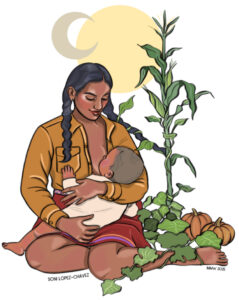 Seven years ago, Indigenous Milk Medicine Week (IMMW) was born from grief, ceremony, and community truth-telling. It began as a collective heartbeat, a call to uplift Indigenous lactating families whose stories, care practices, and health needs were largely invisible in public health and maternal-infant care. Since then, IMMW has grown into a national and international movement, reaching across continents and generations to honor Milk Medicine as a life-giving force of sovereignty, cultural resilience, and enduring relationality—one that heals, protects, and affirms our right to feed our babies anytime, anywhere, until we’re done.
For us, Milk Medicine is more than nourishment. It is a ceremony. It is a living, dynamic knowledge system that connects us to our ancestors and to our babies, to our land and to our futures. It’s not just about the act of feeding; it’s about what feeding represents: kinship, governance, love, and liberation.
This year’s IMMW theme, “Unapologetically Indigenous: Love, Landback, and Liberation”, holds these truths at its center:
- Love as ceremony and kinship, not just emotion, but responsibility and reciprocity across generations.
- Landback as the reclamation of our practices, languages, and places of power.
- Liberation as the right to raise our children in balance, rooted in health sovereignty and cultural safety.
As a practicing birthworker, a Two-Spirit person, a once-lactating parent, and the Founding Director of the Indigenous Milk Medicine Collective, I’ve experienced the intensity of this work firsthand. Over the course of nearly eight years and three children, I have spent more than 2,700 days nursing, expressing, donating, and praying through milk. My Milk Medicine journey has accompanied me through marathons, protests, campaigns, healing, and grief. Through it all, Milk Medicine has been my anchor and my resistance.
I trained for my first marathon while still nursing every two or three hours. I didn’t have role models or guides for what it meant to be a lactating athlete; I had instinct, and I followed it. I leaked through training shirts. I forgot pumped milk before the races. I improvised nursing pads with folded sanitary napkins. And I learned to embrace the smell of milk as part of my armor: sour, sweet, sweaty, sacred.
In our communities, lactation is not a private act. Traditionally, it was held in circle, with aunties, grandmothers, and other birthworkers guiding the journey. It was a ceremony, rooted in matrilineal power, place-based knowledge, and intergenerational teaching. Colonization disrupted these practices through family separations, forced sterilizations, formula distribution policies, and the systemic devaluation of Indigenous care.
IMMC, Indigenous Milk Medicine Collective, was created to restore what was never meant to be lost. Through IMMW, our Indigenous Milk Medicine Conference, and year-round education and organizing, we support Indigenous parents, midwives, doulas, lactation professionals, and healers in reclaiming our practices, centering our voices, and building the future we deserve.
In 2024, we hosted our first Indigenous Milk Medicine Conference and were deeply moved by the response. Over 630 people registered from 40 U.S. states, 338 tribes, and eight countries. Participants included doulas, midwives, ILCs, IBCLCs, clinicians, and traditional healers. Sixty-five percent of attendees identified as Indigenous. They gathered to learn, teach, grieve, and strategize around topics like hormonal changes, neurodivergence, systemic harm, and the epigenetics of healing.
Milk changes DNA. So do we. Milk Medicine is not a metaphor. It is governance. It is protection. It is resistance. As we move toward our 2025 celebration, Indigenous Milk Medicine Week continues to spotlight stories, knowledge, and leadership that have been historically erased. It is also a call to action. We are not only fighting for cultural recognition, but also for infrastructure, compensation, policy shifts, and lasting systems change that affirm lactation as a right, not a privilege.
So what does Milk Medicine mean to me?
It means we are not guests in these systems—we are reminders.
We are the ground beneath the table.
We are the ones who remember.
We are reclaiming our right to raise our children in balance.
We are shaping futures with every drop.
Unapologetically Indigenous. Fiercely in love. Always in ceremony. This is Milk Medicine.
More reading:
Please send your story ideas to Kylie at [email protected]
Supporting Breastfeeding Families–Today, Tomorrow, Always
Please consider donating to La Leche League USA.
Your gift helps support this blog and the website!
Donations of any amount are gratefully accepted. Thank you!
Follow us on:

Leave a Comment
Posted: August 12, 2025 by Yael Breimer
Milk Medicine Is a Ceremony: Love, Landback, and Liberation in Practice
By J. Lyons Echo-Hawk, Founder, Indigenous Milk Medicine Week
Editor’s note: New Beginnings is celebrating Indigenous Milk Medicine Week (IMMW), August 8-15. This year’s theme is: Unapologetically Indigenous: Love, Landback, and Liberation. You can learn more about the theme and events for this year in the article below and from Indigenous Milk Medicine Collective.
For us, Milk Medicine is more than nourishment. It is a ceremony. It is a living, dynamic knowledge system that connects us to our ancestors and to our babies, to our land and to our futures. It’s not just about the act of feeding; it’s about what feeding represents: kinship, governance, love, and liberation.
This year’s IMMW theme, “Unapologetically Indigenous: Love, Landback, and Liberation”, holds these truths at its center:
As a practicing birthworker, a Two-Spirit person, a once-lactating parent, and the Founding Director of the Indigenous Milk Medicine Collective, I’ve experienced the intensity of this work firsthand. Over the course of nearly eight years and three children, I have spent more than 2,700 days nursing, expressing, donating, and praying through milk. My Milk Medicine journey has accompanied me through marathons, protests, campaigns, healing, and grief. Through it all, Milk Medicine has been my anchor and my resistance.
I trained for my first marathon while still nursing every two or three hours. I didn’t have role models or guides for what it meant to be a lactating athlete; I had instinct, and I followed it. I leaked through training shirts. I forgot pumped milk before the races. I improvised nursing pads with folded sanitary napkins. And I learned to embrace the smell of milk as part of my armor: sour, sweet, sweaty, sacred.
In our communities, lactation is not a private act. Traditionally, it was held in circle, with aunties, grandmothers, and other birthworkers guiding the journey. It was a ceremony, rooted in matrilineal power, place-based knowledge, and intergenerational teaching. Colonization disrupted these practices through family separations, forced sterilizations, formula distribution policies, and the systemic devaluation of Indigenous care.
IMMC, Indigenous Milk Medicine Collective, was created to restore what was never meant to be lost. Through IMMW, our Indigenous Milk Medicine Conference, and year-round education and organizing, we support Indigenous parents, midwives, doulas, lactation professionals, and healers in reclaiming our practices, centering our voices, and building the future we deserve.
In 2024, we hosted our first Indigenous Milk Medicine Conference and were deeply moved by the response. Over 630 people registered from 40 U.S. states, 338 tribes, and eight countries. Participants included doulas, midwives, ILCs, IBCLCs, clinicians, and traditional healers. Sixty-five percent of attendees identified as Indigenous. They gathered to learn, teach, grieve, and strategize around topics like hormonal changes, neurodivergence, systemic harm, and the epigenetics of healing.
Milk changes DNA. So do we. Milk Medicine is not a metaphor. It is governance. It is protection. It is resistance. As we move toward our 2025 celebration, Indigenous Milk Medicine Week continues to spotlight stories, knowledge, and leadership that have been historically erased. It is also a call to action. We are not only fighting for cultural recognition, but also for infrastructure, compensation, policy shifts, and lasting systems change that affirm lactation as a right, not a privilege.
So what does Milk Medicine mean to me?
It means we are not guests in these systems—we are reminders.
We are the ground beneath the table.
We are the ones who remember.
We are reclaiming our right to raise our children in balance.
We are shaping futures with every drop.
Unapologetically Indigenous. Fiercely in love. Always in ceremony. This is Milk Medicine.
More reading:
Please send your story ideas to Kylie at [email protected]
Supporting Breastfeeding Families–Today, Tomorrow, Always
Please consider donating to La Leche League USA.
Your gift helps support this blog and the website!
Donations of any amount are gratefully accepted. Thank you!
Follow us on:
Facebook
Instagram
Category: Indigenous Milk Medicine Week
Subscribe to Our Blog
Upcoming events:
La Leche League Meetings